
Warning: This blogpost is loooong with a LOT of pictures 🙂
In Calama we did the 10.000 km service on Christians bike which led to a few days of eating good food and mostly watching movies. Calama wouldn’t really be so much to write about, except one very important fact; It’s where my mom is born, so therefore it’s the best city in the world!


After Calama we headed straight for San Pedro de Atacama where we did a lot of touristy things (like flamingo watching) and ate more great food.


One of the most important things we did in San Pedro was to acclimatise to the altitude. The town is at about 2400 m.s.l. That was a good starting point and we made sure to make trips to higher altitude during the days. “Go high – sleep low” is a good rule to follow and we hoped it would be sufficient preparation for Bolivias higher altitudes.


In to Bolivia
After stocking up on food, water and some Bobs (Bolivian money) we checked out from Chile in San Pedros immigration office and drove about 45 km to the nearest entry point to Bolivia. There we filled in the required paperwork under the rough guidance of the immigration officer. Bolivia was dubbed “the least friendly country for tourist in the world” by the World Economic Forum. The immigration officer did lend some credibility to that claim, we could only hope it would get better.
He told us that we had to drive about 6 km to get the paperwork done for the bikes, or if there wasn’t anybody there, we had to go 80 km to the next entry point. We set of straight through “Laguna Verde”.


Of course there wasn’t anybody at the first point so we drove to the next one. The roads where…terrible. Sand, soft gravel and kilometre after kilometre of wash-board required all of our concentration so we barely had time to watch the amazing surroundings. When we arrived at the aduana we felt a bit lightheaded and experienced a light tingling sensation in our fingers. A look at the altitude told us we where at 5000 m.s.l 🙂

Thanks to the wonderful app ioverlander we found a nice canyon to camp in for the first night. We felt the altitude (4500 m.s.l) but got no headache, our previous acclimatisation was working!

Uyuni and the Salar de Uyuni


After three days of tough riding through really beautiful landscapes we finally arrived to Uyuni.


After this we felt ready for the salar. It was…beautiful and surreal.


Felt like driving on hard snow/ice but with very good grip. White as far the eye could see 🙂 We spent one night camping at Isla del Pescado. It was quite windy in the evening but around nine p.m the wind died down and we had a calm and quiet night.


In the morning we met a family that was out picking cactus fruits. They gave us a few and showed us how to eat them, sweet!


On to Potosi and Sucre
After the salar our bikes got a really nice wash (30 bobs per bike) to get rid of all the salt.

A couple of really nice burritos later and it was time to continue onward to Potosi. The way there was a really nice surprise; a very good and sinuous tarmac road through the mountains.

Once again we found a nice hostel thanks to ioverlander; Vicuña hostel. There we got a nice surprise since the owners spoke Swedish! So nice to speak a bit of Swedish with other people 🙂
Minas de Plata

Potosi has a very rich (and sad) history. It’s located by Cerro Rico de Potosi and is the worlds largest deposit of silver.


It has been mined since the sixteenth century under very bad conditions for the workers. It is estimated that around eight millions indigenous workers have died in the mines, as well as a lot of slaves brought in from Africa.


Today the citys narrow streets are filled with cars and pollution which makes it hard to walk around in. We took a tour to the mines which was a very humbling experience. To this day people are working under basically the same conditions as when the Spanish ruled.


Our guide Anthony, himself a former mine worker, took us to the mines and gave us (with a mix of humor and melancholy) a real insight to the lives of the mine workers and their rituals.


Sucre – The capital
Nope, La Paz is not the capital of Bolivia. All the decisions are made in La Paz but the capital is still Sucre. We are not very fond of citys, specially when they are filled with cars and pollution. But if you manage to get away from the narrow streets, it offers some nice views (and zeebras).


We spent two nights in the city and went on to Cochabamba. The way there became long and rather adventurous, specially at the end.
The way to Cochabamba

The road took us through the mountains and the scenery was very nice. We managed to take a wrong turn which led us to some gravel roads. Luckily we realised our mistake and doubled back. The road changed from tarmac to cobblestone…and continued to be cobblestone mile after mile. Must be some kind of world record; the longest cobblestone road in the world?
Thanks to the wrong turn (and very nice scenery) we arrived at Cochabamba just as the sun where setting. A rule we try our absolute best to hold is: Never drive when it’s dark. Just when it looked like we where going to make it before darkness we came upon a blockade. Arriving to Sucre we had the same experience, people blocking the roads.
There wasn’t much to do but trying to weave through the people and the barricades. The people didn’t seem to mind and we got directions of alternative routes. This led to a very interesting ride with two river crossings in the middle of the city! After successfully navigation around four different blockades we finally reached the inner city.
By now it was dark and getting late. The hostel we had in mind was a bit outside the inner city but we decided to go there anyway. And then….I got a flat tire. Luckily in low speed and I had no problem stopping. By this point we had driven a bit more than 400 km and where exhausted. Our intercom had run out of battery so I couldn’t tell Christian what had happened. He realised quite fast and managed to find me again. What to do? A car stopped and told me there was a repair shop just on the next block (!). I went to take a look and the guy told me to bring the bike and he would fix it right away. The only unfriendly people we have found in Bolivia so far are people in the immigration offices. Six patches later and my bike was ready to go again 🙂

We arrived at the hostel, Hostal Las Lilas around 9.30 PM and were welcomed by a couple of happy danish guys and a very hairy dog.


It turned out to be a very very nice hostel where we met a lot of nice people. We then spent a couple of days searching for new tires for the bikes. Not an easy thing to do in Bolivia, but after a lot of driving around and help from a lot of people we managed to get two Pirelli MT 21 for our back tyres. The front is still good to go.
Next stop: La Paz and the death road!


 Efter att ha kört 2200 kilometer på två dagar (med bil) till Puerto Natales och hämtat Lucy (mamma i mitt fall) och Kent siktade vi norrut. Oändliga stäpper, träd som växer horisontellt p.g.a hård vind och massor med Guanacos (Sydamerikas motsvarighet till kameler?) kännetecknar den Argentinska sidan av Anderna. De oändligt raka vägarna i kombination med hård vid gjorde oss glada över att sitta i en bil för denna del av resan.
 Första anhalten blev den lilla orten El Chalten. Långt innan man kommer fram ser man Mount Fitz Roys karakteristiska toppar vid horisonten. Kontrasten mellan dem och tom, platt stäpp bidrar till att göra bergskedjan än mer imponerande. Som på väldigt många ställen i Chile och Argentina finns det väl uppmärkta vandringsleder. En dags vandring (som blev betydligt tuffare än tänkt) gjorde oss glada över att bilen var automatväxlad. På bensinstationen 12 mil från Chalten:

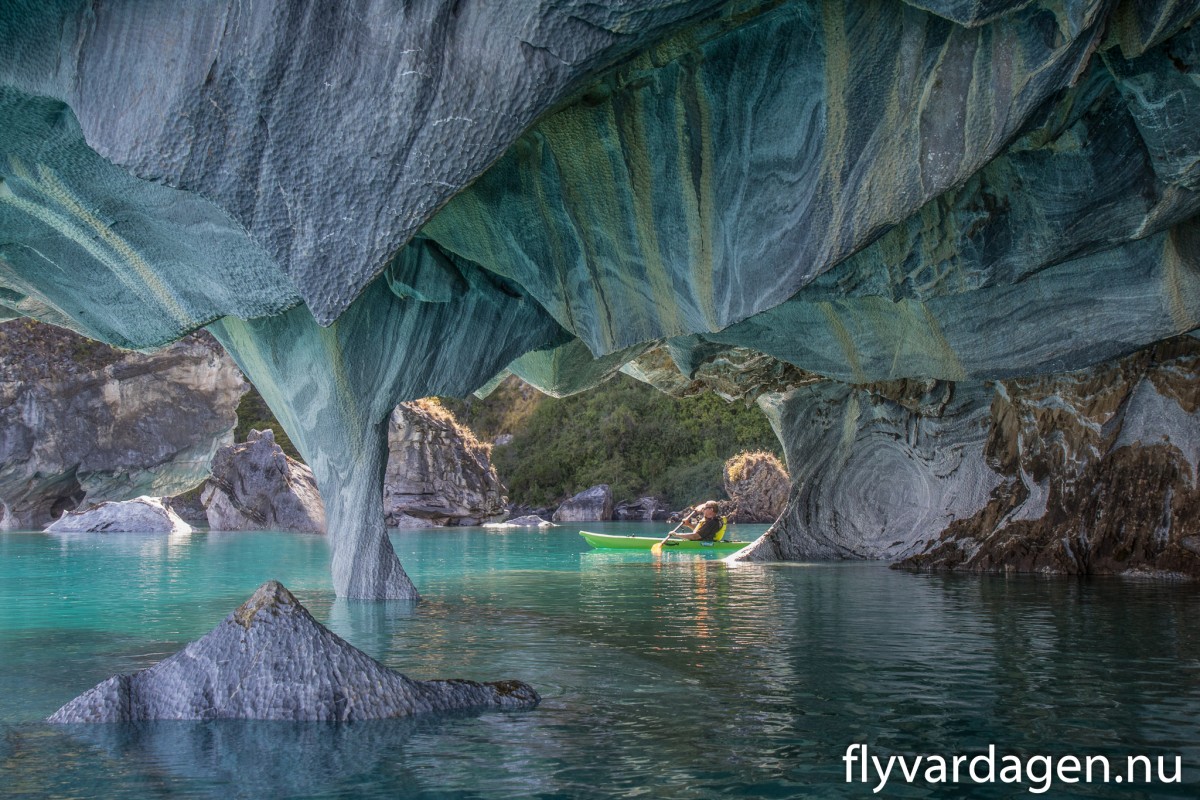
 I närheten av Puerto Río Tranquilo hyrde vi glasbottnade kajaker och tillsammans med guiden Nelson paddlade vi iväg mot Capillas de Marmol, eller marmorkatedralerna. Varken Lucy eller Kent hade någon större vana (för att uttrycka mig milt) med att paddla kajak…men efter en kort introduktion gick det hur bra som helst och det blev en mycket minnesvärd tur.

